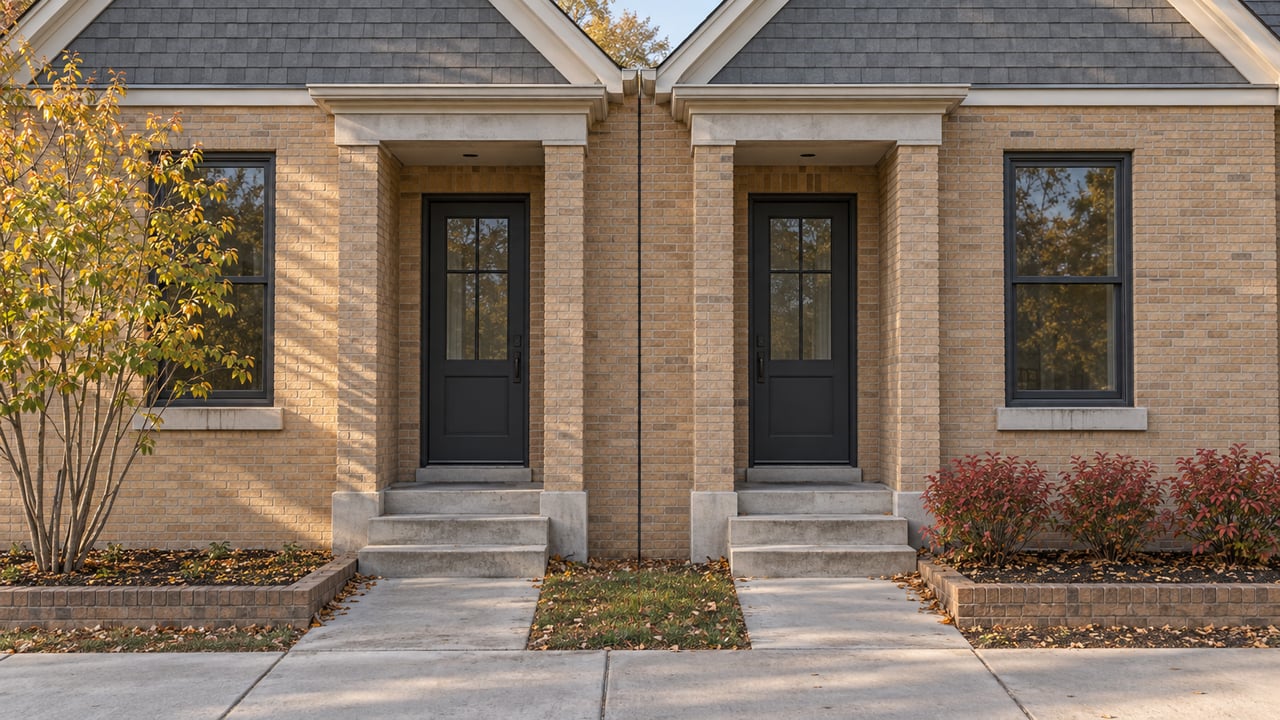
What Actually Follows You Home When You Buy Infill in Ritchie
What does a closing date actually close?
For most buyers in Ritchie, the answer they assume is everything. The city signed off, the builder handed over keys, the lawyer registered title, so whatever paperwork exists must already be settled. That assumption holds fine in a lot of Edmonton neighbourhoods. It holds less well in Ritchie, where narrow historic lots and a fast-moving infill market mean some of the most consequential documents in your purchase are still active on the day you take possession.
Edmonton approves infill through two separate permits, reviewed by two separate teams. The Development Permit checks whether the massing, setbacks, height, and lot coverage are allowed. The Building Permit, reviewed later, checks the actual construction against the Alberta Building Code. Buyers tend to think of these as one approval. They aren't, and the gap between them is where the risk lives.
Once a Development Permit is issued, Edmonton gives neighbours 21 calendar days to appeal it to the Subdivision and Development Appeal Board. If nobody appeals, the permit is fully valid at the end of that window. If someone does, construction can sit on hold for six to ten weeks while the board rules. On a straightforward mature-core lot, the full path from decision to shovel-in-ground runs four to six months. On a lot with a variance or a tree preservation issue, closer to six to nine.
Here's why that matters if you're shopping Ritchie specifically. If you're buying a brand new build that hasn't hit possession yet, or a resale lot next door to one still under construction, you're inside a process that has a legal appeal clock attached to it, not just a builder's schedule. Ask your agent to pull the permit file and confirm where a specific project sits relative to that 21-day window before you treat a completion date as fixed.
| Permit Stage | Typical Timeline | What It Means for You |
|---|---|---|
| Development Permit review | 4 to 8 weeks | Confirms massing, setbacks, and use are allowed on that lot |
| Appeal window | 21 calendar days | A neighbour can still challenge the permit during this period |
| Building Permit review | 3 to 6 weeks after DP clears | Code review of structure, mechanical, electrical, plumbing |
| Total, straightforward lot | 4 to 6 months | Standard mature-core infill with no variance |
| Total, complex lot | 6 to 9 months | Lot involves a variance request or tree preservation plan |
Most Edmonton buyer guides describe a variance as an exception, something that flags a project as slightly off the standard path. In Ritchie, treat it as background noise instead. The neighbourhood's original lots are narrower than most of Edmonton's other mature communities, which means a given infill project is more likely than not to have needed a variance tied to lot width or setback just to get built at all. That isn't a red flag on its own. It's simply how a compact, century-old street grid absorbs new construction.
What it does mean is that "check the permit file" stops being a formality and becomes real due diligence. Ask for the complete file, including any variance approved, and confirm what was actually granted rather than assuming the finished house matches a generic set of setback rules. On lots this tight, the narrow footprint also concentrates drainage into a smaller area, so confirming that final lot grading passed inspection, and understanding how surface water is directed relative to the neighbouring lot, is worth a direct question rather than an afterthought.
Ritchie and neighbouring Bonnie Doon consistently rank among Edmonton's most active infill communities by permit volume, and interest in the area is visible beyond MLS data. The Infill Development in Edmonton Association ran a public walking tour through Ritchie in July 2026, taking attendees through residential and commercial infill projects in the neighbourhood. That kind of organized interest doesn't happen in areas where redevelopment is occasional. It happens where the pattern is established enough that an industry association builds a whole event around it.
For a semi-detached or duplex product, review the party wall documentation. According to REIN Canada, a registered party wall agreement typically grants an easement allowing each owner access to the other's property for the purpose of maintaining, repairing, or rebuilding the shared wall.
Have your realtor or lawyer pull that agreement before you remove conditions, not after possession. Confirm what it actually obligates you to, not what you assume a shared wall implies.
There's a second, quieter quality question tied to that same wall. The Alberta Building Code sets a minimum Sound Transmission Class rating of 50 for party wall assemblies, but that's a floor, not a target, and better builders exceed it. A 50 STC wall means you'll likely hear your neighbour's television. A 60 STC wall means you often won't know they're home. Buyers almost never ask a builder what STC rating their party wall assembly actually achieves, or what insulation system and stud configuration produced it. It's a five-minute question that tells you more about long-term livability than a walkthrough will.
As of May 2026, the small number of active semi-detached infill listings in Ritchie were pricing between roughly $500 and $616 per square foot, a range wide enough that a buyer comparing two listings side by side could see a genuinely different price for what looks like a similar product on paper. Across the wider Edmonton market, semi-detached homes averaged $424,322 in August 2026, up slightly from a year earlier but down from the previous month, according to figures from the Realtors Association of Edmonton. Ritchie's per-square-foot numbers sit well above that broader average, which is the walkability and resale-depth premium buyers already know they're paying for.
What's less obvious is that this premium is also what makes the paperwork worth verifying. A property commanding $500 to $600 per square foot on a narrow, appeal-window-sensitive lot deserves the same scrutiny you'd apply to a much larger transaction, not less, simply because the finishes look move-in ready.
The broader market gives buyers real room to ask for that scrutiny right now. Edmonton-wide sales fell close to 10 percent year over year in August 2026, inventory climbed roughly 15 percent compared to the year before, and the composite benchmark price sat at $426,900, essentially flat. RAE's board chair described the fall market as one where supply is ample and demand needs to keep pace to avoid further softening. In a market with that much inventory sitting unsold, asking a seller for the complete permit file, a copy of the registered party wall agreement, and the builder's STC documentation as conditions of your offer is a reasonable, low-friction request, not the kind of demand that costs you the deal.
Does the 21-day appeal window apply to a home that's already built and listed for resale? No. Once a Development Permit has cleared its appeal period and construction is complete, that window has already closed. It matters most for buyers purchasing a spec home still under construction, or a resale property directly adjacent to a lot with an active Development Permit.
Can I ask to see the party wall agreement before I write an offer? Yes. It's a public document registered on title, and reviewing it is a normal part of due diligence for any semi-detached or duplex purchase in Ritchie.
Is a variance a sign the builder cut corners? Not on its own. Given how narrow Ritchie's historic lots tend to be, a variance for lot width or setback is common across many well-built infill projects in the neighbourhood. The file itself, not the fact that a variance exists, is what tells you whether the project was handled properly.
If you're weighing a specific Ritchie infill listing and want someone to actually pull the permit file and the title before you write, that's exactly the kind of groundwork our team at The Anderson Co. does before a client makes an offer, not after. Reach out and we'll walk the file with you.
This article is general information, not legal, tax or financial advice. Consult a qualified professional about your situation.

Through curated systems and a collective approach, we deliver a positive experience in one of the most significant transactions of your life. Establishing foundational relationships built on trust, education, transparency and fun, we are committed to supporting our clients in a successful real estate journey. Contact us today!